Introduction to electronics
Here is its content:
1. Models vs reality
2. Sources - types and characteristics
3. Main electronic components
4. Measurements and instruments
5. Connections
Sources - types and characteristics
The task of the sources is always to provide electricity to circuits or systems. But in many cases it is not the supplied power that is the most important parameter, but other voltage or current properties, and then we are talking about signal sources.
Each circuit, simple (battery and resistor) or complex (e.g. phono amplifier and loudspeakers), can be seen from the point of view of the selected pair of terminals as composed of an energy source or a signal source and a load:
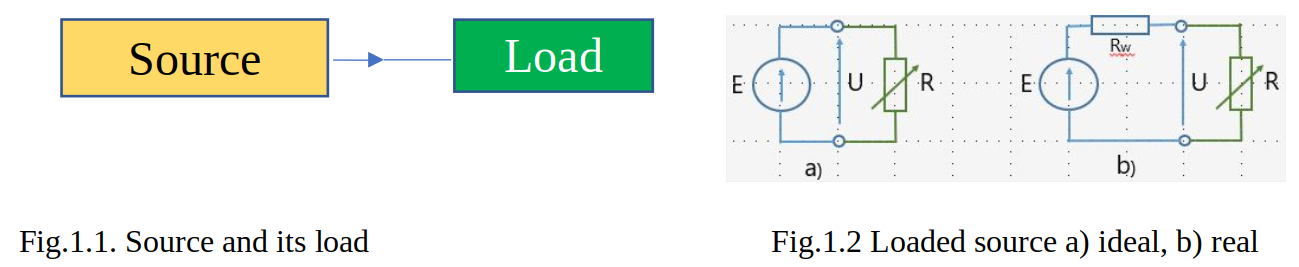
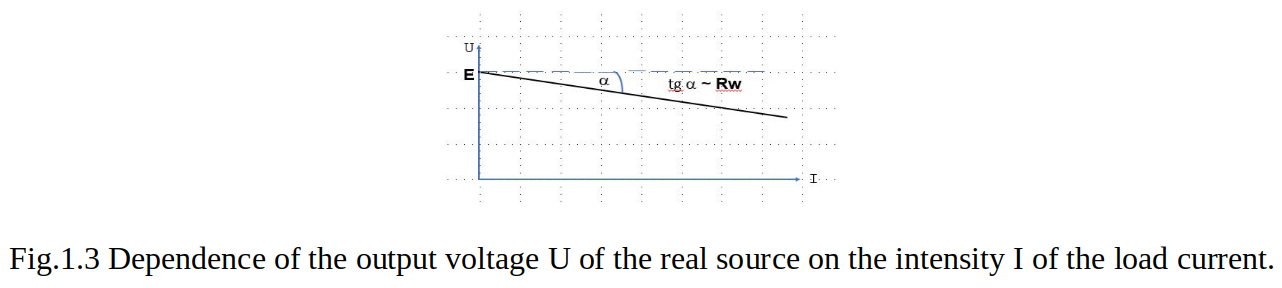
If we consider an ideal voltage source (we will also learn about the current source later), then the voltage at the load U (and this is what we are interested in) is equal to the electromotive force (EMF) E, regardless of the changing load. However, if the source is real and has an internal resistance Rw different from zero, then the voltage U on the load with resistance R is smaller than EMF E due to the flow of the load current I through the resistance Rw and depends on the current I, so it is: U = E – RwI.
With changes in the load resistance R, the voltage U and the current intensity I must be treated as variable. Their mutual dependence is illustrated in Fig. 1.3. It is a straight line passing through the point with coordinates (0, E) and inclined to the I axis at an angle a such that \( tg(\alpha) \) is proportional to Rw. It is easy to notice that in the case of an ideal voltage source, Rw is equal to zero and a straight line runs parallel to the axis I of the current intensity.
Time to give a strict definition: an ideal voltage source is a two-terminal element (two-terminal connector) that maintains the voltage E between its terminals, regardless of the value and direction of the current flowing through it (the figure in Tab.1). The phrase "regardless of the direction of the current" may be surprising, after all, we are used to thinking that in the external circuit the current flows only from the terminal of the source with a higher potential (conventionally from "plus") to the terminal with a lower potential (down to "minus"). Yes, but this is true only when it comes to the external circuit of this source and there is one source in the circuit, and yet there may be more of them. An example is the process of charging a battery (first source) from a power supply (second source): then the charging current flows into the battery and is therefore negative for it.
A characteristic parameter of an ideal voltage source is the potential difference between its terminals, called the electromotive force E, expressed in volts. The same term for a real source requires the addition that E = U only if no current flows from the source to the load. By the way, let us notice that while for an ideal source only one parameter E is needed to describe it, two parameters E and Rw are needed for a real voltage source. And this is a general regularity: when creating models of real elements, it is necessary to introduce more and more parameters for their reliable description (dream conflict with reality). The list of basic ideal and real elements used in electronics is presented below.
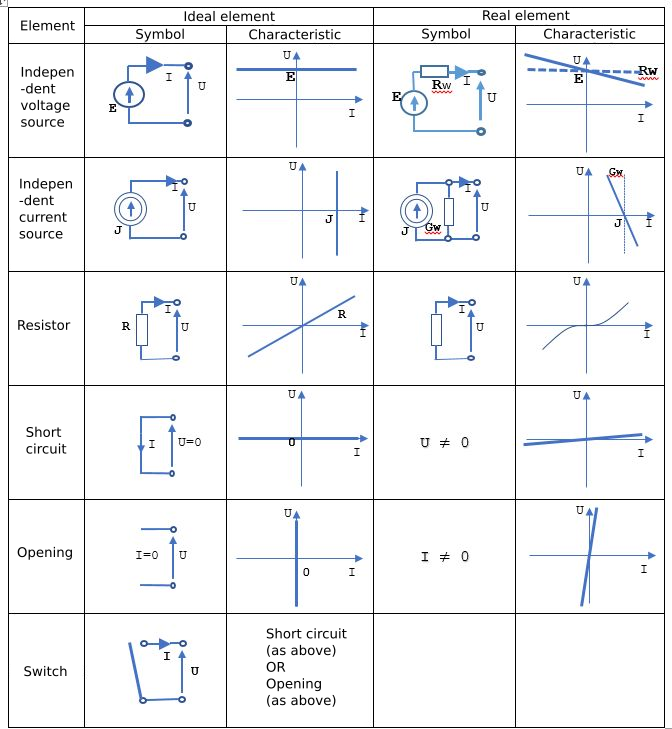
In electronics, apart from voltage sources, current sources are introduced and used. They are defined as follows: an ideal current source is a two-terminal element (two-terminal block) that supplies the load with a current of I, through its terminals, independent of the value and polarity of the voltage at its terminals. A characteristic parameter of the current source is the current efficiency J, expressed in amperes. Real current sources have an internal conductivity Gw expressed in siemens [symbol S, inverse ohm]. Therefore, the current supplied to the load I = J - GwU. In electronics, many different types of current sources are used, but also many electronic components behave under certain conditions, such as current sources, e.g. photodiodes, transistors, pentodes, etc.
The voltage and current sources presented so far belong to the group of independent sources, which means that their main characteristic parameters: electromotive force E and current efficiency J are parameters, i.e. constant quantities, independent of voltages and currents in other circuits in which they are used. Apart from such independent sources, dependent voltage and current sources (ideal or real) are introduced in electronics, characterized by the fact that their characteristic quantities, i.e. electromotive force E and current efficiency J are not parameters and depend on voltages or currents in other branches of electrical network, e.g., the output circuit of a bipolar transistor behaves like a real current source driven by base current, whereas unipolar transistor behaves like a real current source driven by a voltage on its gate. Concluding this introduction to sources, it must be stated that they can provide both DC and time-varying voltages and currents.