Semiconductor Diodes - theoretical Introduction
Introduction
A diode is a semiconductor structure, i.e. a p-n junction, which has two metal ends: a cathode (-) and an anode (+).
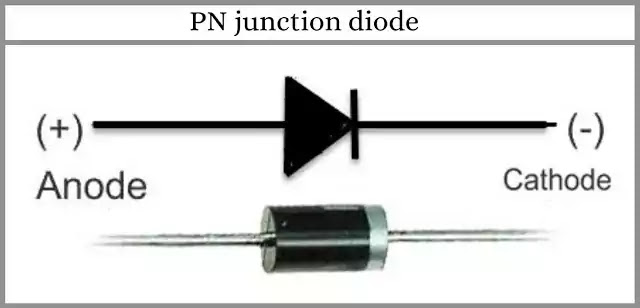
The p-n junction conducts current only in one direction, from the anode to the cathode, which is called the forward bias. However, in the opposite direction, i.e. from the cathode to the anode, it practically does not conduct electricity. This direction is called the reverse bias. The described behavior of the p-n junction is widely used in the construction of modern electronics, e.g. in the case of semiconductor diodes.
Diodes are classified according to various criteria, e.g.:
- material from which the diode is made: germanium, silicon, gallium arsenide
- constructions and manufacturing technologies: point diodes, layer diodes)
- the physical structure of the junction and the type of doping: p-n, m-s, heterojunction
- purpose resulting from the properties of diodes; diodes stand out:
a) rectifiers (for AC rectification),
b) universal (used in low-power detection and rectifying systems),
c) Zener - stabilitrons (to stabilize voltages and limit signals),
d) pulse - switching /Fast recovery/
e) capacitive (varicaps and varactors)
f) Schottky
g) photodiodes (light sensors, radiation converters)
h) electroluminescent (LED)
i) with negative characteristics - generation, tunnel, avalanche, BARITT
j) microwave detection (PIN, Schottky diodes)
k) Gunn generation microwaves, LSA