Applications of operational amplifiers - theoretical introduction
Time domain integrator
Let's move on to a more detailed description of the operation of the integrator in the time domain. We will start with an integrator circuit with an operational amplifier, and then we will compare it with a simple passive two-port device, which performs a similar role as an integrator, but in an imperfect way.
Assuming that the operational amplifier is ideal and its open-loop gain A is infinite, for the integrator in Fig.4 we have:
\( u_{in} = Ri \\
u_{out} = -u_C \\
i = C \frac{du_C}{dt} \)
where after transformations we get:
\( u_{in} = -RC \frac{du_{out}}{dt} \Rightarrow u_{out}(t) = - \frac{1}{RC} \int_{0}^{t}{u_{in}(t)dt}+u_{out}(0) \)
where \(u_{out}(0)\) is the output voltage at time t = 0, which must be known (initial condition). The system is therefore a perfect integrator, as the output voltage is proportional to the integral of the input voltage.
If the input voltage has an unit step form: \(u_{in}(t) = U_1 \bf{1}(t)\) and \(u_{out}(0) = 0\) (Fig. 7), then the output voltage is : \(u_{out}(t) = −\frac{U_1}{RC}t\), so it is a linear function of time.
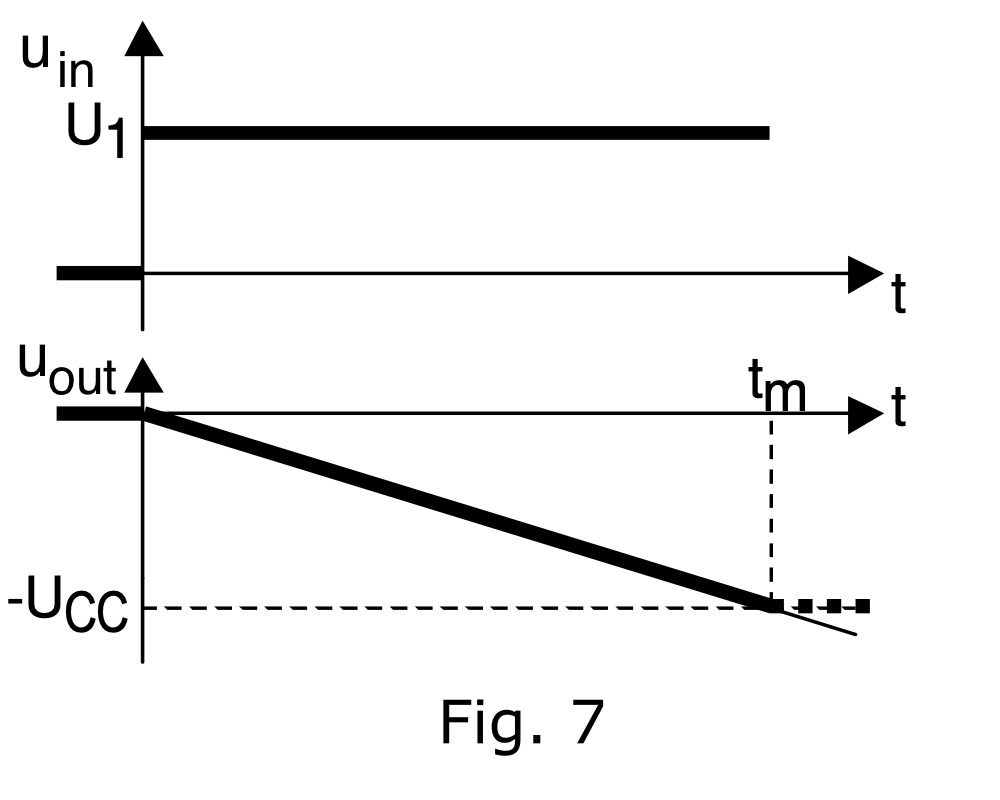
The quality of integration by various electronic systems is assessed on the basis of the reaction of these systems to the excitation with a unit step and the deviation of the obtained waveform from the straight line. It can be seen that with the given assumptions, the discussed integrator integrates perfectly, but at the same time, in the integrator with the operational amplifier, the output voltage cannot exceed the supply voltage \(-U_{CC}\) and therefore the actual waveform of the output voltage is shown in Fig.7 by a bold dashed line (for \(t > t_m= \frac{R_C U_{CC}}{U_1}\)).
If the ideal integrator is excited with a sequence of rectangular pulses with an amplitude \(U_1\), a period \(T\) and a duty cycle of 1⁄2 (Fig. 8), the output voltage has a triangular waveform with an amplitude \(U_2 = U_1\frac{T} {2}RC\) (in order not to saturate the op-amp output, the condition \(U_1 < U_{CC}4RC/T\) must be met).
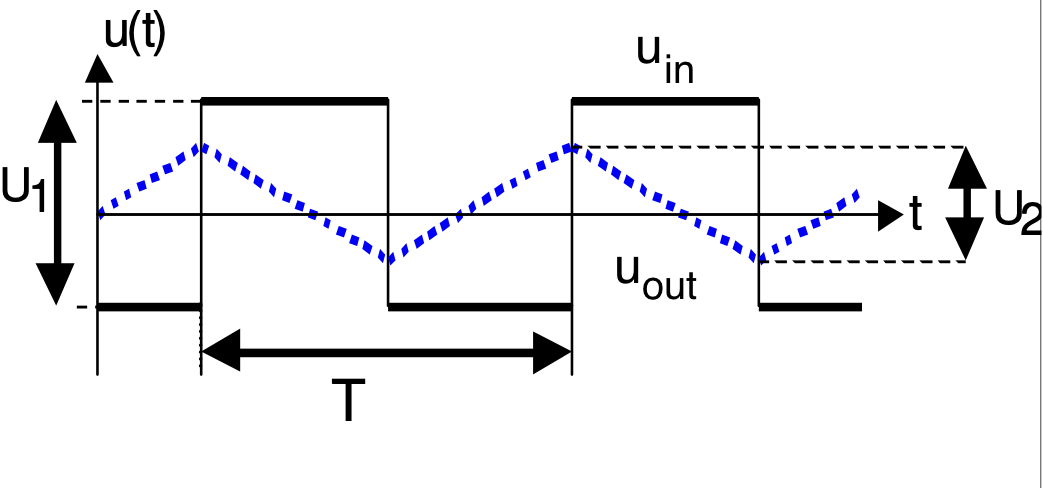
Figure 8